
National League of American Pen Women Vinnie Ream Banquet Keynote Address
April 24, 2026
By Kim Villanueva
National Organization for Women (NOW) CEO
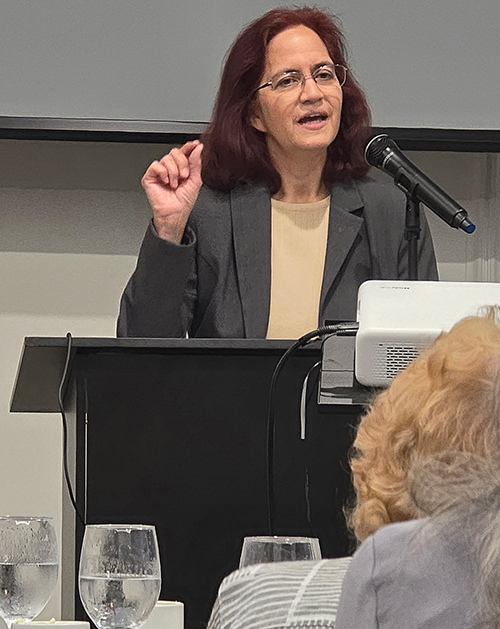
Good evening, and thank you for your warm welcome. It is truly a pleasure and an honor to be with you tonight.
I feel especially honored to be here for a few personal reasons.
I live in Dupont Circle, and I often walk past the Pen Arts Building on my way to work. It’s one of those places that makes you pause because you can feel the history in it.
Every time I walk by your building, I know it stands for something important.
And I admire your gardens! Beautiful landscaping is truly an art form.
I also wanted to note that I’m originally from Springfield, Illinois, the home of Abraham Lincoln. His statue in the U.S. Capitol was sculpted by Vinnie Ream, the namesake of tonight’s banquet.
Vinnie Ream was just 18 years old when she won that commission — the youngest artist ever to do so, and the first woman.
I admire that at a time when women were rarely taken seriously as professional artists, she not only secured the commission — she had to defend it, publicly and persistently, against critics who questioned whether a young woman belonged in that space at all.
She worked under scrutiny. She worked under doubt. And yet, she completed it. She claimed her place.
Her work was not only artistic, it was an act of persistence. An act of visibility. And, in its own way, an act of resistance. And perhaps just as importantly, it created a path — however narrow at first — for other women to follow.
That legacy is part of what we are honoring tonight.
I also want to recognize the Central New York Branch of the National League of American Pen Women, which is hosting this Biennial as it celebrates its 100th anniversary. Congratulations and happy anniversary!
And a special thank you to your Vice President Nancy Dafoe, who is also a proud member of NOW’s own Central New York chapter — just another example of the cross-pollination between the arts and the women’s movement.
A century of supporting women in the arts — of creating space, building community, and ensuring that women’s voices are heard — is no small achievement. Think about what that represents. Generations of women encouraging one another. Mentoring one another. Making room for one another.
That kind of continuity does not happen by accident. It happens because people choose, again and again, to invest in one another’s voices. It is a legacy worth celebrating, and one that continues to shape the future. So, congratulations on your legacy of achievement.
I also wanted to note that in what sometimes feels like a previous life, I served as chair of the Springfield Area Arts Council. In that role, I had the great privilege of helping to provide grants to local artists, similar to the grants that you provide to women artists.
We also encouraged young people to express themselves through the national Poetry Out Loud competition. We never won at the national level, but we provided opportunities for many high school students to express themselves through the spoken word.
But what I remember most is not just the work itself, but the moment when someone realized their work mattered enough to be supported. That recognition can be transformative.
Before that, I earned a degree in journalism from the University of Illinois. I’ve always believed in the power of words, storytelling, and creative expression to shape how we understand the world. So being here with the National League of American Pen Women tonight feels, in many ways, like a full-circle moment.
Yours is an organization that has, for well over a century, affirmed something the world has too often overlooked: That women’s voices matter. That women’s creativity matters. And that women’s work — on the page, on the canvas, and in the world — has the power to shape history.
You were founded at a time when women journalists were excluded from professional spaces. So women created their own spaces — to connect, to support one another, and to ensure their voices were heard. That act — of creating space where none existed — is an essential form of resistance. And it is also an act of art. Because art, at its core, is the insistence that our experiences are worth expressing — and worth hearing and seeing.
That same spirit was present 60 years ago, on June 30, 1966, when NOW was founded right here in Washington, D.C. Our origin story is really very similar to yours, although our “sisterhood of talented women” came together in the 1960s, not the 1890s.
Delegates had gathered for a national conference on the status of women. Many had spent years documenting women’s inequality, only to be told, once again, that meaningful action would have to wait. The night before, Betty Friedan — who was a writer and a journalist — met with a small group of women to strategize in her hotel room. They were frustrated. They were impatient. They were mad as hell. And they were no longer willing to accept any delays.
When conference organizers refused to take up a resolution addressing sex discrimination in employment, it did not stop them. It galvanized them.
At lunch the next day, Betty Friedan wrote three letters on a napkin: N–O–W. Another woman placed $5 on the table and said, “Put your money down and sign your name.” Twenty-eight women stepped forward. And in that moment, NOW was born.
Betty Friedan’s napkin isn’t in the Smithsonian, but the first NOW button is.
NOW’s origin story is often told as a political story. But it is also a creative one. Because it required imagination, the ability to envision a different future, and the courage to begin shaping it. That is something artists have always done. And nowhere is that more evident than in the long arc of women’s rights — where art and advocacy have always moved together.
As a journalist, author and activist, Betty Friedan understood that art impacts advocacy. Every form of art — from the written word to the visual arts — inspires us to see a better world, and to take action to create it. Some of the most important early examples of feminist art as advocacy are literary. Speeches delivered at women’s conventions such as Seneca Falls were disseminated via magazines and newspapers.
During the last half of the 19th century, when the “Dauntless Three” came together to form the Pen Women organization, there was no internet or Facebook. The widespread publication of women’s own words was revolutionary — and created a sense of community that powered the movement forward. It showed other women the path to participate in it and create change.
In the years surrounding the Seneca Falls Convention, women did not simply organize. They wrote, they spoke, they published. Their words traveled farther than they could. They created community before there was infrastructure. Before there was Tik Tok.
They built momentum before there was power. They found ways to reach one another across distance and difference. And across generations, women artists have continued to challenge what is seen and what is valued.
When Mary Cassatt painted women’s lives with depth and dignity, she quietly expanded what and who was considered worthy of artistic attention. When Judy Chicago created The Dinner Party, she reclaimed women’s history and set a table where women’s history could no longer be ignored.
When Helen Reddy sang “I Am Woman,” it became more than a song. It became an anthem. A declaration of identity, strength, and collective voice that people could carry with them — into their lives, their work, and their activism. And when Pearl S. Buck — an honored member of this very organization — wrote about the lives of women across cultures, she expanded how readers understood both difference and common humanity. Her work reached audiences far beyond national borders, reminding us that storytelling has the power not only to reflect the world, but to connect it.
These works are different in form. But they share a common purpose: to make women visible. To make women heard. And to insist that women’s experiences matter.
Another example comes from suffragist Maria W. Chapman, who transformed criticism into defiance. She wrote a satirical poem to respond to male critics who claimed women had stepped outside their “proper sphere” in “brainless confusion and meaningless chase.”
In response, Maria wrote:
“Confusion has seized us, and all things go wrong;
The women have leaped from ‘their spheres,’
And, instead of fixed stars, shoot as comets along…
And are setting the world by the ears!”
What was meant as criticism became, in her hands, something else entirely. A reframing. A declaration. And even, in its way, a kind of celebration of women. Because sometimes resistance begins with refusing the language that confines you and transforming it into something that liberates.
We see that again in the words of Sojourner Truth, whose speech — later known as “Ain’t I A Woman?” — cut through abstraction and forced her audience to confront reality. She said: “I could work as much and eat as much as a man — when I could get it — and bear the lash as well! And ain’t I a woman?”
There is no ornament in her language. No distance. Just truth, spoken plainly and powerfully. And because of that, it endures.
We see it in poetry that carried movements forward. In 1912, Charlotte Perkins Gilman wrote:
“Not for herself…
But for the child who needs a nobler mother,
For the whole people needing one another —
Comes woman to her hour.”
And her poem, “Song for Equal Suffrage,” was inspired by Julia Ward Howe’s famous “The Battle Hymn of the Republic”:
“Day of hope and day of glory! After slavery and woe,
Comes the dawn of woman’s freedom, and the light shall grow and grow
Until every man and woman equal liberty shall know,
In Freedom Marching on!”
These were not just words. They were signals. They told other women: You are not alone. There is a movement. And there is a place for you in it. And perhaps most importantly, they invited participation. They made the movement feel accessible.
As someone trained as a journalist, I was taught that telling the truth clearly matters. Artists do something just as powerful. You make people feel that truth. You give it texture. You give it memory. And sometimes, you give it the kind of emotional force that moves people from understanding — to action.
And we see that happening right now. We see it in protest art, in spoken word, in murals that appear overnight in response to injustice. Not commissioned. Not curated. But urgent. Art that doesn’t wait for permission — it responds to the moment.
Here’s what history tells us: Every right that women have today exists because someone refused to accept the status quo. Someone marched. Someone organized. Someone voted. Someone wrote! Or painted, or sang. Someone risked everything to make change possible.
We are moved by art and inspired by artists to challenge accepted wisdom, push back against inequity and injustice, and stand our ground, even when the attacks are loud, coordinated, and relentless. And today, we need that clarity and courage more than ever. Because we are at another inflection point.
Many people — especially younger women — feel that the systems shaping their lives are increasingly out of reach. The cost of living is rising. Economic insecurity is growing. Reproductive freedom is under sustained challenge. And the Equal Rights Amendment still has not been fully recognized as part of the U.S. Constitution.
At the same time, younger generations are creating art in ways that would have been unimaginable just a few decades ago. They are using digital platforms, visual storytelling, spoken word, and new forms of media to document their experiences and demand change. They are building audiences. They are building community. And they are continuing a tradition that is much older than any platform — the tradition of using art as creative expression to challenge power and imagine something better.
But history reminds us that progress has never been inevitable. It has always required people who were willing to speak, to create, and to persist. Often without recognition. But always with purpose.
And that brings us back to art as resistance. Not always loud. Not always confrontational. But steady. Intentional. And transformative.
A poem shared at the right moment — such as Amanda Gorman’s words during Barack Obama’s first inauguration. An image that reframes how we see the world — like Dorothea Lange’s photos of poverty during the Great Depression. A story that gives voice to what others have felt but could not express — like Betty Friedan’s Feminine Mystique. A work that stays with someone long after they’ve encountered it.
These acts of art matter. They accumulate. They endure. And they shape the cultural foundation on which lasting change is built. Because policy can mandate behavior. But culture shapes belief. And belief shapes what people are willing to defend.
In the meantime, we must step up where systems have failed. Mutual aid networks and community safety nets are helping women survive the gaps left by broken systems — covering rent, childcare, medical bills, and legal needs when public supports fall short. But survival should not depend on charity.
Stronger labor standards matter. Higher wages, predictable schedules, paid family and medical leave, and real protections against discrimination and harassment help women earn more and lose less, especially when they care for children or aging family members.
States and municipalities can lead by improving conditions in women-dominated sectors like care and service work, while expanding affordable housing and cost-of-living protections. Reliable childcare and accessible education increase women’s ability to work, pursue higher-paying credentials, and remain in the labor force across all stages of life.
Ending gender-based price discrimination, eliminating sales taxes on menstrual products, and reducing out-of-pocket health costs would immediately cut the extra fees women pay simply to meet basic needs. We need public policies that give women the same opportunities to advance in their careers that men have long relied on — opportunities often made possible by women’s unpaid labor.
That means real economic security matters. It means removing the everyday penalties women still pay simply to live. And it means building systems that don’t force women to rely on resilience alone just to get by.
These were principles that led to the formation of the National League of American Pen Women in 1897. And that is why the National Organization for Women will not rest until the Equal Rights Amendment is fully recognized as the 28th Amendment to the Constitution. Because without it, equality remains just a promise.
When equality is not explicit, it is negotiable. And women’s rights should never be negotiable. Equality delayed is equality denied.
Not long ago, I stood outside the U.S. Supreme Court and looked up at the words carved above its entrance: “Equal Justice Under Law.” But without constitutional equality — without the Equal Rights Amendment — those words are just stone and shadow.
It is time for women’s full equality. And as we consider the path forward, it is worth remembering that change has never been driven solely by those in positions of power. It has been shaped, again and again, by individuals and communities who chose to act. Who chose to create. Who chose to persist. Often quietly. But with conviction.
The arts have always been part of that story. They have sustained movements. They have carried ideas across generations. And they have reminded us not only of what we are fighting against but of what we are fighting for.
The arts inspire us. Grass-roots activism empowers us. Sisterhood unites us.
The future is not something that simply arrives. It is something we shape. And we shape it in many ways. Sometimes through policy. Sometimes through organizing. And often through art. Through the quiet insistence that women’s lives, women’s stories, and women’s work belong at the center, not the margins. The kind of insistence that led Judy Chicago to set a table where women’s history could no longer be ignored. The kind of voice that turned Helen Reddy’s “I Am Woman” into something more than a song, but into a shared declaration of strength.
Those acts endure because they did more than express something. They made it visible. They made it collective. They made it real. And every time I walk past your building in Dupont Circle, I’m reminded: This work is not abstract. It lives in places like this. And in people like you.
Susan B. Anthony once said, “Failure is impossible.” Not because success is guaranteed. But because the work continues across generations. Across disciplines. And across communities.
We are truly in it for the long haul. The responsibility — and the opportunity — rests with all of us. And in this room, it is carried forward through your words, your art, and your enduring commitment to free expression.
That is how change takes root. And how it lasts.
If history has taught us anything, it’s this: When women create, organize, and refuse to be invisible, change is not just possible. It is unstoppable.