
Piano Recital at Pen Arts Building
By Elizabeth Lauer, Music Editor | With reporting by Grace Reid
Last fall, the Pen Arts building was the setting for “Women Composers of the 19th – 21st Centuries,” a recital by pianist Jeri-Mae G. Astolfi. The program was constructed around five works for solo piano by music member Betty R. Wishart, plus repertoire by five European women.
It is quite typical for a pianist to open her program with an easy-on-the-ears suite — short, varied dances — from the Baroque era. Astolfi’s imaginative rethinking of this tradition was a piece by the English composer Ethel Smyth, who lived 200 years after the heyday of the Baroque. Her “Suite in E Major” comprises four traditional dances: gavotte, bourrée, minuet, gigue. A fine curtain-raiser.
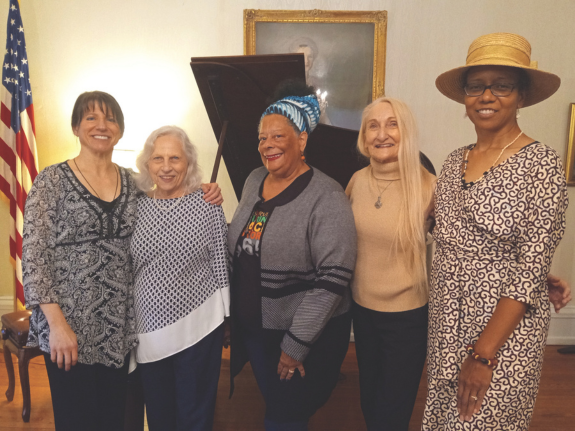
“Remembrance,” the first Wishart work on the program, delineates a favored approach to keyboard writing: Long, limpid melodic lines sing over a gently rolling left-hand accompaniment, amassing more sound and substance as the piece progresses. Thereafter came “Variations on ‘Oh, Shenandoah,’” in which Wishart treats the beloved, rather free folk song to a re-hearing that is redolent of improvisation: A variation begins, but may not be completed; rather, it melds into the next, with a distinct change of piano sound — flowing, then chordal, next in the minor mode, then the tune in the bass, ending in full instrumental color, rich and expansive.
Wishart’s “Preludes in Memoriam” is a set of eight tributes to and evocations of figures in history. Astolfi chose five: four 20th century women — Audrey Hepburn, Amelia Earhart, Sylvia Plath, and Anna Pavlova — plus Jane Austen.
Grace Reid shared enthusiastically: “They were my favorites because I could hear in my mind’s ear each personality via Wishart’s musically witty creations.”
Astolfi performed two sections of Wishart’s “Vibes”: “Blue” and “Quiescent.” Lasting 90 seconds, “Blue” promotes insouciance with its walking bass, swinging harmonies, and occasional grace-note flips. In contrast is “Quiescent,” a waltz that gracefully spins, dips, sways. The pianist beautifully brought out the character of these small gems. She concluded the program with Wishart’s “Toccata II,” a whiz-bang, nonstop tour de force that features the particular excitement of having both hands occupy the same richly resonant center range of the keyboard in percussive, rapid-fire harmonies. An occasional contrasting dash to the outer reaches, then back to rat-a-tat action made for an exciting closer. A question of how Wishart’s works actually sound is easily answered: Every selection on this program is available (CD or video), performed by Astolfi. There are also publications.
Along with the opening Smyth “Suite,” the program was interlaced with compositions from four 19th and early 20th century European women: two each from France and Germany. The multitalented composer, arranger, opera singer, and pianist Pauline Viardot — born in Paris in 1821 to Spanish parents — was represented by her “Mazourka,” a three-minute kind of easy-listening version of the Polish dance. Paris-born Cécile Chaminade was active internationally, both as composer and pianist. Her works comprise songs, ballet, and orchestral scores, plus an enormous listing for piano. She was awarded France’s National Order of the Legion of Honor, and Queen Victoria was a fan. Astolfi presented Chaminade’s charming “Étude de Concert” (subtitled “Automne”), a subtle work of gently flowing melody over rich harmonic motion, in the instrument’s warm midrange — with one brief show-off gush, near the close, of high-treble hijinks.
It is for their association with prominent men that the reputations of two early 19th century German women musicians rest: Clara Wieck Schumann, wife of Robert; and Fanny Mendelssohn, sister of Felix. For both Mendelssohns, fleet-fingered agility — nonstop playing in bursts, roulades of notes — is the sine qua non of piano music. It is front-and-center in Fanny Mendelssohn’s “Wanderlied” — brilliant, virtuosic. The range of the piece gives a seasoned performer the opportunity to display her dazzling, professional chops.
The fine extent of Schumann’s pianistic and creative acumen is evident in her “Romance in B Minor”: a defined shape, starting gently in the center of the instrument, gradually rising in melodic fervor — subtly enriched deeper in the bass — with a satisfying surcease that leads to gently shaded sounds in the concluding moments.
What the fortunate audience that gathered at the Pen Arts Building heard went beyond the piano repertoire choices that span more than two centuries. Indeed, it was more than a program of music exclusively by women. The audience was treated to what every composer hopes and strives for, dreams about: a live performance — in this case of Betty R. Wishart’s piano works, by Jeri-Mae G. Astolfi, an accomplished and sensitive artist. It is this coming together of creator and interpreter that brings — through the medium of the pianist’s skills and imagination — the composer’s ideas and fantasies to listening ears.