
The 2026 Biennial Music Performance: A Review
By Elizabeth Lauer, Music Editor
The atmosphere in the parlor of Pen Arts, early in the afternoon on April 25, was inviting, calling to mind the collegial informality of storied Schubertiades in early 19th-century Vienna. In keeping with Biennial tradition, prize-winning musical works of four Pen Woman members — Mary Fineman (multiple awards), Jerry Casey, Betty R. Wishart, and Grace Reid — were presented.
Sounds from Mary Fineman bookended the hourlong program. Her piano trio, “Who You Were Then and Always,” was performed by J. Pelton (violin), Thillman Benham (cello), and Lyn Loewi (piano). It proved to be a perfect choice to open up the room to music. The piece begins gently, in the midrange of the piano, coaxing listeners to attend, as strings join in, with versions of melodic line and accompaniment, all in an easy-going pulse. After slipping from major to minor modes, and back again, the skein of melodic lines settles, after barely four minutes, in G Minor. Fineman captured the audience for the conclusion of the program by both speaking about and playing, from memory, several of her prize-winning works.
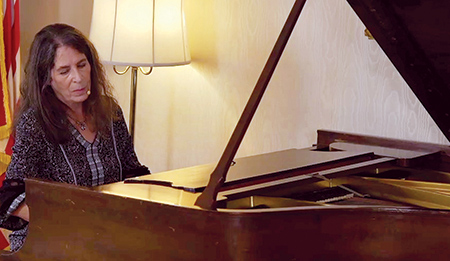
The composer’s personal charm and engaging manner are reflected in her music. Her performing skills are evident in her seemingly effortless combining of singing her own lyrics and handling the piano. This she did in her Vinnie Ream competition prize-winner, “Suite from the Faraway Pavilion,” a four-part piece that is a felicitous combining of piano and (sometimes) voice. Each section has its own clear profile and texture; all are redolent of lyrical flow, warm harmonies, and an occasional, well-timed surprise. The composer struck a chord about women in music with Ursula Plaichinger’s story: a 27-year-old violist, in 2003 she was the first woman ever to be a member of the then-158-year-old Vienna Philharmonic at its New Year’s Concert. Fineman’s pieces that closed the afternoon presentation were her Biennial 2022 winners: “And the World Spins ‘Round, ’Round,” plus “I Thought I Saw You.” She included her 2026 Biennial first-place winner, “Love Song” and an encore, “Shechinah.” Throughout, she presented her own music and experiences as a composer: singing, playing, talking. For the audience, a gift: live performance. Bobby Short would smile.
Casey’s imagination opened up the chamber’s acoustics with her scoring — a coupling of mezzo-soprano and flutes (C and G) — of Paulann Peterson’s poem, “Riches.” The poet’s honors include serving as Oregon’s sixth poet laureate. She allowed Casey to use repetition of her words, thereby granting the composer complete freedom to explore the many possibilities of combining voice and instruments. The audience heard Catie Brooks and Sara Zhu in a focused, intense presentation of the eight-minute work. Several instances of flutter-tonguing purred in the early moments: warm, alluring. Thereafter, the piece proceeded with the two voices sometimes in partnership, only to divide in opposition; occasionally, in question-and-answer. The low, throaty register of the G flute prevailed for most of the piece. But in the last two minutes, it was the C flute to show dazzle and stratospherically fly off at the close.
Wishart’s “Requiem for Dreams” has a sit-up-and-pay-attention advisory: “commissioned to promote awareness of domestic violence.” Soprano Viviana Goodwin and pianist Tongyao Li brought the four sections of the musical autobiography — words and music by Wishart — to the audience with power, clarity, and expressivity. The opening, “Fortune or Fate,” is a lyrical detailing of a woman’s ambitions to be a performer, the music quite pacific, almost conversational. “Normal?” questions societal demands, as unease creeps in. With “Marriage” comes the unexpected: a sudden, loud splat! by both hands slapping the keyboard. The pianist plays — the sounds are urgent, sometimes rough, with tone clusters — and speaks loudly, insistently. “No more!” concludes the piece. Quiet repetition of these two words, with long-held o’s, brings welcome, soothing surcease to the listener.
For those who believe the fallacy that a composer is the best performer of her works, it’s crucial to state that a composer must prepare as does any other player, that fashioning a piece of music is a world apart from presenting it in public. That is the task that Reid accepted in performing her piano work, “Beware of Wolves in Sheep’s Clothing!” Each of the four sections is titled. “Idealization” sets up a circle of harmonies and flowing scales that is a template for the collection. Buzzing contrary motion sets up “Devaluation,” which soon takes up the tune-and-accompaniment scheme. “Discard” has some amusing staccato moments, while quasi-martial sounds are apparent in “Hoovering: Reclamation.” Reid’s clear presentation sounded definitive.
To fund this concert, I made a donation and a grant, the latter of which members fully matched. It’s clear that we all had our money’s worth.